
Insights ·March 5, 2026
Photographing Apartment Communities for Lease-Up Success: A Charleston Developer's Guide
What apartment community photography looks like when it's done for leasing teams, not for architects' portfolios. A Charleston developer's guide to multifamily lease-up photography — amenity spaces, model units, aerial site context, and the timing window that matters.
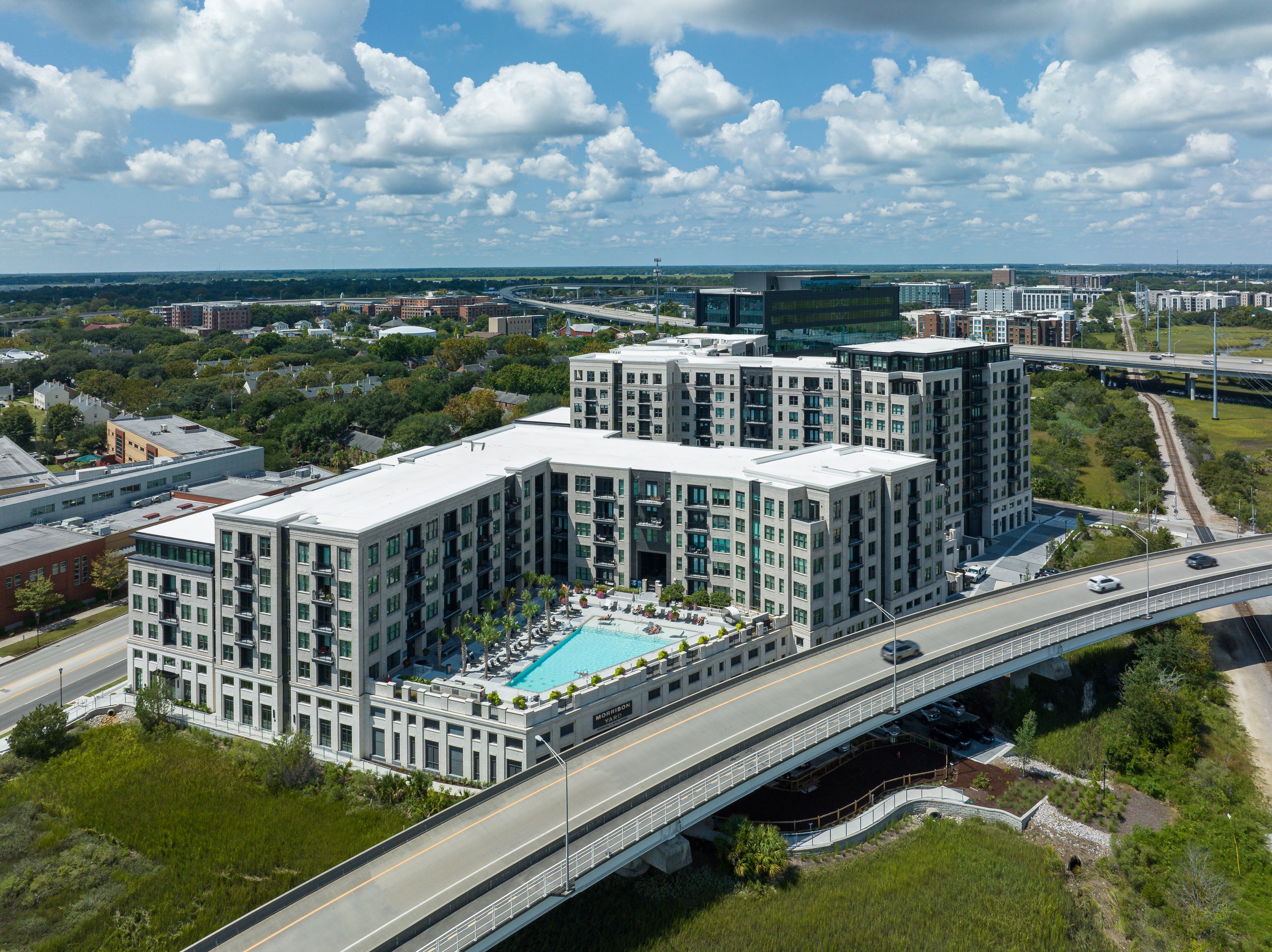
Charleston is in the middle of a multifamily build cycle that started before the pandemic and shows no sign of slowing. Morrison Yard. Fifth & Broadway. The new mixed-use sites along the upper peninsula and the developments quietly being approved at the Mt. Pleasant and West Ashley edges. Developers are putting hundreds of millions into the metro’s housing supply, and the leasing teams responsible for filling them up are working with photography assets that were, in most cases, commissioned by the architect for portfolio purposes — not by the leasing team for lease-up.
Those are two different photography deliverables. Here’s why that matters, what apartment community photography actually looks like when it’s done for leasing rather than for awards, and what Charleston developers should expect from a vendor on a new lease-up.
Architect photography vs. leasing photography
The architectural photography commissioned at substantial completion serves the design firm’s portfolio, AIA submissions, and design press. The compositions are intentional, the light is patient, and the spaces are typically empty — clean, abstract, photographed at twilight or in the perfect blue hour the architect’s reputation deserves.
That’s the wrong photography for lease-up. Prospects browsing apartments.com or your community’s own site need to imagine themselves living there. They want to see the kitchen at the warm afternoon light a Tuesday would actually offer. They want to see the amenity deck with furniture they’d use, not staged-out emptiness. They want the gym to look usable, the lobby to look welcoming, and the unit interiors to read at full residential proportion, not architectural-magazine framing.
Leasing photography is closer to high-end hospitality photography than to architectural editorial. The same camera, the same color discipline, the same person operating the equipment — but a different brief.
What apartment community photography should cover
For a Charleston-area multifamily lease-up, the typical photography deliverable set looks like:
Aerial drone establishing imagery. Property situation, neighborhood context, the property’s relationship to downtown / IOP / Mt. Pleasant / wherever the market positioning lands. Establishes the answer to "where am I?" before the prospect goes any further.
Building exteriors at the right light. Twilight is iconic for architects; bright midday is what a renter Googling the property will actually be looking at. Both have their place; the leasing-side deliverable usually weights toward the latter.
Amenity spaces. Pool, fitness center, club room, dog wash, package rooms, work-from-home lounges. These are the differentiators that justify the lease premium over a competitor down the street. Photograph them at active hours when light makes them feel inhabited.
Common-area circulation. Lobby, mail room, elevator vestibules, courtyards, corridor moments that distinguish a well-built community from a generic one.
Model unit interiors at multiple floor plan types. Studio, one-bedroom, two-bedroom, townhome. Each plan needs its own anchor set: kitchen wide, kitchen detail, living wide, bedroom, bathroom, balcony or patio if applicable. ILS systems are voracious; a community with seven floor plans needs roughly seven separate mini-shoots within the larger session.
Sense of place. Walks to coffee, neighborhood detail, the bit of Charleston the property is selling alongside the unit. Often the differentiator in a market saturated with comparable units.
Where multifamily photography goes wrong
The two most common mistakes Charleston developers make on lease-up photography:
Inheriting the architect’s photo set unchanged. Beautiful images, wrong job. The leasing team needs warm, lived-in, full-spectrum residential photography. Architectural-portfolio shots feel cold and empty to a renter making a decision.
Stretching the photo deliverable across the wrong timeline. Photographing the day after substantial completion gets you empty corridors, unfinished landscape, no furniture in the amenity spaces, and no operational signs of life. The right window is 30 to 60 days after first occupancy — long enough that staging has happened, landscape has had time to settle, and the amenity spaces look like they’re actually serving residents.
Who we’ve worked with
For developers, GCs, and architecture firms operating in Charleston multifamily — McMillan Pazdan Smith, BL Harbert International, MB Kahn Construction, Choate Construction — the photography we produce serves both audiences when the brief is set up correctly. The architectural set for portfolio and awards, plus the leasing set tuned for ILS, social, and the property’s own marketing site. Both can be produced over a single visit when the schedule allows.
Getting started on a lease-up
If you’re planning lease-up photography for a Charleston multifamily property opening in the next 12 months, the right time to scope the photography is 60 to 90 days before first delivery. That window lets us coordinate around the actual operating reality of the property — landscape settled, amenity furniture in place, the staging that a leasing-team photographer wants to capture but a portfolio photographer doesn’t need. Reach out to discuss scope and timing; lease-up photography is typically quoted on a per-project basis based on plan count and amenity scope.
Continue Reading